
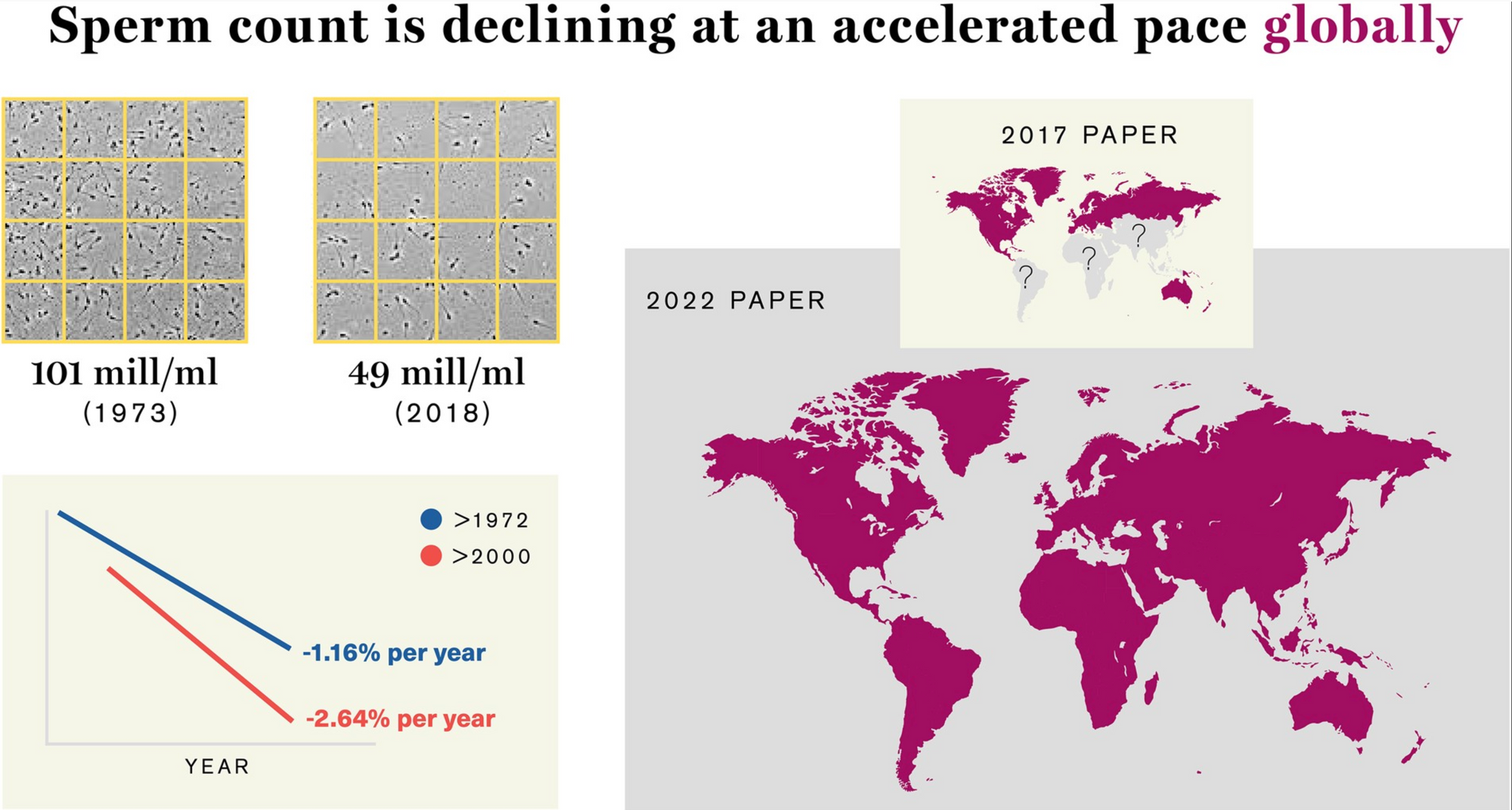
Researchers from Israel recently reported that sperm counts are continuing to decline across all areas of the globe. Previous studies had identified this trend in North America, Europe, and Australia. This study expands the finding to now include South and Central America, Africa, and Asia. It also reported the troubling observation that the rate of male fertility decline appears to be accelerating. The research team identified and analyzed 223 studies that reported on semen testing collected from 1973-2018 from all areas of the globe. They reported that the estimated total sperm count for a randomly selected man on earth has been dropping by 4.7 million sperm per year (1.4% per year) and that this rate of decline appears to be accelerating. This represents an astounding 62% decline in sperm counts from 1973 to 2018.
This clear and continuing decline in sperm counts across the globe is part of a larger global crisis in male reproductive health. In addition to declining sperm counts, researchers have also reported alarming increases over the past several decades in rates of boys being born with undescended testicles, the increasing commonality of testicular tumors, and even changes in the timing of puberty. On top of that, adverse paternal lifestyle factors like obesity and smoking that can impact fertility continue to impact millions of men every day. Reproductive health testing and examination for men is therefore becoming increasingly important, but delays or avoidance of fertility testing and examination remains very, very common.
Fortunately, advances in at-home diagnostics and ongoing clinical research have made the identification and management of male fertility issues easier and more effective than ever. Accessible programs like Swimmers can help men to identify and treat fertility problems early, from the privacy of their own homes.